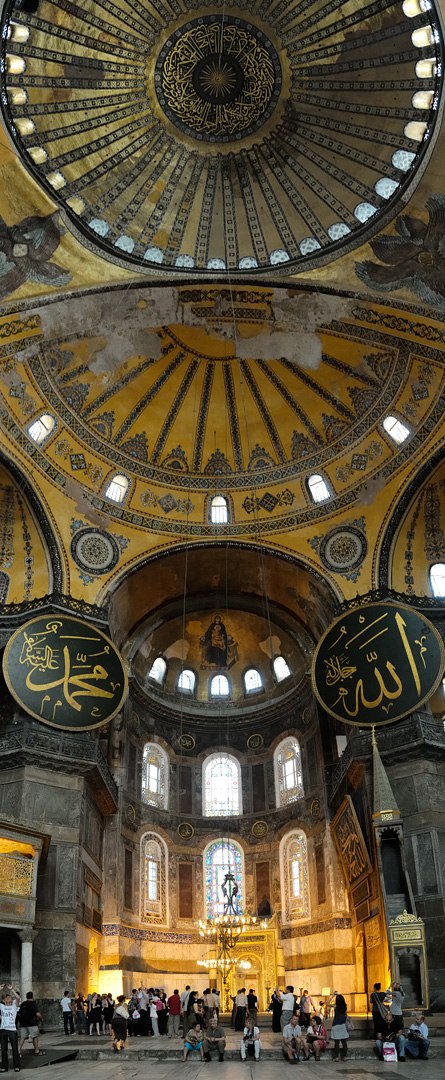
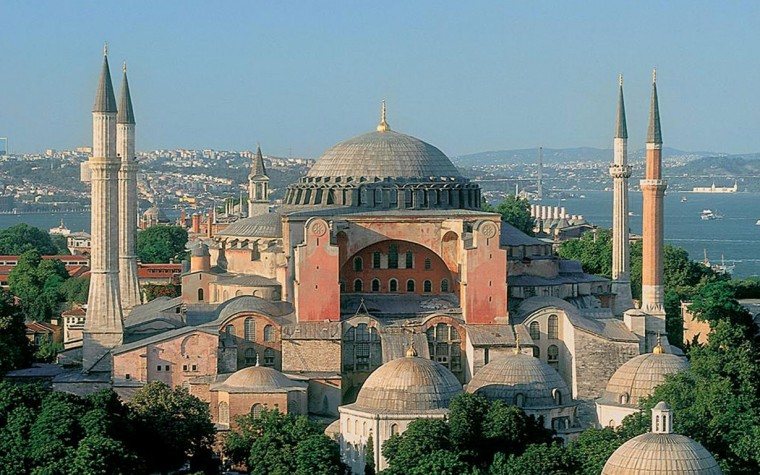
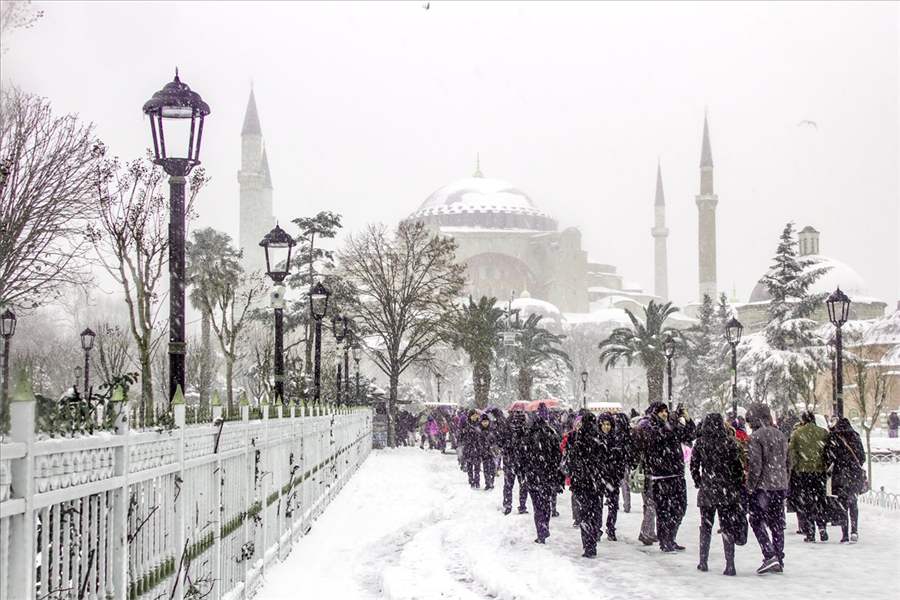
Nothing quite prepares you for the moment you step inside. However many photographs you have seen, the interior of Hagia Sophia still does something to people — you watch them stop, tilt their heads back, and go quiet. That dome floats about fifty-five meters above the floor, ringed with windows, and for nearly a thousand years there was no larger enclosed space anywhere on earth.
It was built astonishingly fast. The Emperor Justinian commissioned it in 532, immediately after riots had burned the previous church to the ground, and it was finished in 537 — five years and ten months. He did not hire builders, he hired thinkers: Anthemius of Tralles and Isidore of Miletus were a mathematician and a physicist. That is why the building feels less like masonry and more like an argument about geometry. The forty windows at the base of the dome were the trick; they flood the join with light so the whole weight of it appears to hover.
Then in 1453 the city fell to Mehmed II, and the great church became a mosque. What we find beautiful is that almost nothing was destroyed. The Christian mosaics were eventually covered, not chiselled away, and centuries later they emerged again. Today you stand under a golden Byzantine Christ and eight enormous Ottoman calligraphic roundels in the same glance — Muhammad and Allah, Abu Bakr and Umar, hanging where saints once looked down. Very few buildings on earth hold two faiths in one room so calmly.
Look for the small things. There is a column in the north aisle, damp to the touch, that pilgrims have worn a hole into with their thumbs — the "weeping column". Up in the gallery, on a marble balustrade, a bored Viking guard of the Varangian Guard scratched his name in runes some time in the ninth century. He is thought to have written something close to "Halfdan was here", which is a wonderfully human thing to find in a cathedral.
Our guide's tip: Go up to the upper gallery — most visitors never bother, and it is where the finest mosaics are, including the Deesis with its extraordinarily tender face of Christ. It is also the only place you can properly photograph the dome. Since 2020 Hagia Sophia is an active mosque again, so it closes to visitors during prayer times and shoulders and knees should be covered; women are asked to cover their hair. We always build the timing around the prayer schedule so you never queue for nothing.
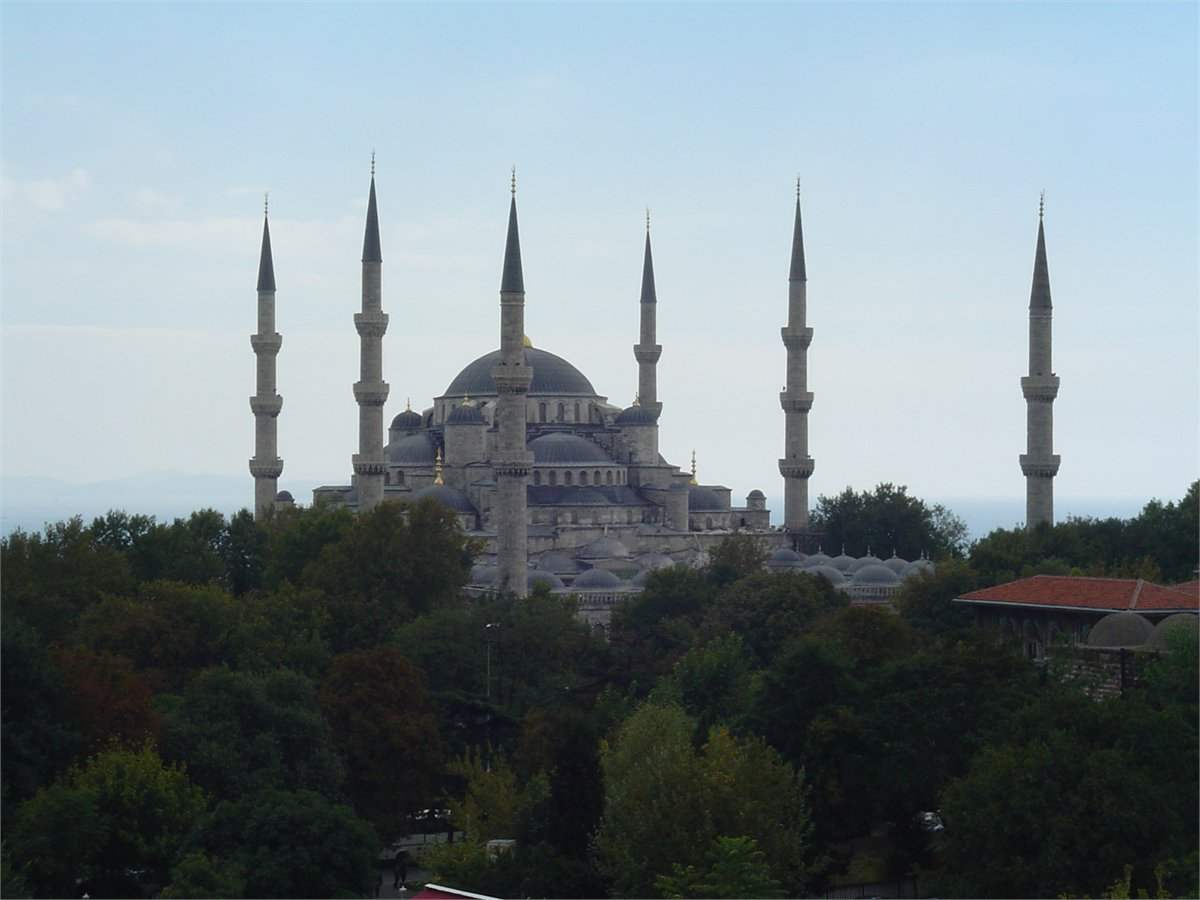
Its real name is the Sultan Ahmed Mosque, and nobody in Istanbul calls it that. The nickname comes from what happens inside: somewhere around twenty thousand hand-painted İznik tiles line the lower walls and galleries, and in the right light the whole room takes on a cool blue wash, like being underwater in the best possible way.
Sultan Ahmed I was young and ambitious — he began it at nineteen — and he built it deliberately facing Hagia Sophia, close enough that the two great domes now argue politely across a garden. His architect, Sedefkâr Mehmed Ağa, had trained under the legendary Sinan, and you can feel the inheritance: the building climbs in a careful cascade of half-domes up to the central dome, so that from the outside it seems to swell rather than rise.
Then there is the famous scandal of the minarets. The mosque has six, and at the time only the Great Mosque in Mecca had six. The story told locally is that this caused real offense, and the matter was resolved by paying for a seventh minaret to be added at Mecca. Whether it happened quite so neatly is debated, but the six slim minarets are still one of the most recognisable silhouettes in the world.
Inside, look up at the two hundred and sixty windows — originally filled with Venetian stained glass — and down at the vast red carpet, which is renewed periodically and is one of the reasons the space feels so warm compared with Hagia Sophia's cool marble. Unlike its neighbor, this has never stopped being a working mosque. You will share it with people who have come to pray, and that is rather the point.
Our guide's tip: The tourist entrance is not the main gate — it is on the south side, and knowing that alone saves you a long walk in the sun. Shoes come off, and coverings are provided free at the door, though bringing your own scarf is more comfortable. Come late afternoon if you can: the low sun comes through the western windows and the tiles genuinely turn blue.
Topkapı is not a palace in the European sense. There is no grand staircase, no single monumental façade to photograph. Instead it is a walled world of courtyards, kiosks and gardens on the point of land where the Bosphorus, the Golden Horn and the Sea of Marmara all meet — and for roughly four hundred years, whoever controlled these courtyards controlled an empire stretching across three continents.
Mehmed the Conqueror began it soon after 1453, and the logic of the place is a slow tightening of access. The first courtyard was effectively public. Through the Gate of Salutation, with its two pointed towers, you enter the second — the world of the Imperial Council, where viziers debated while the sultan, famously, could listen unseen through a grilled window above them. Beyond the Gate of Felicity lies the third courtyard, the sultan's own household, which ordinary subjects would never see in their lifetime.
Two sections make most visitors' day. The Harem is the private family quarters — not the fantasy invented by European painters, but a tight, tiled, surprisingly domestic maze where the sultan's mother, the Valide Sultan, often held the real power. And the Treasury holds objects that stop conversation: the emerald-studded Topkapı Dagger, and the Spoonmaker's Diamond, a pear-shaped stone of about eighty-six carats ringed by dozens more. In the Sacred Relics rooms, a Qur'an is still recited aloud without pause, as it has been for centuries.
Do not rush past the terraces. From the marble edge beyond the Baghdad Kiosk you get the view the sultans actually chose this hilltop for — ships turning up the Bosphorus, the Asian shore beyond, and Istanbul doing what it has always done.
Our guide's tip: The Harem needs its own separate ticket and it is absolutely worth it — but it is also where the crowds bottleneck, so we go there first and work outwards. Give the palace three hours minimum. And note it closes on Tuesdays, which catches out a remarkable number of people.
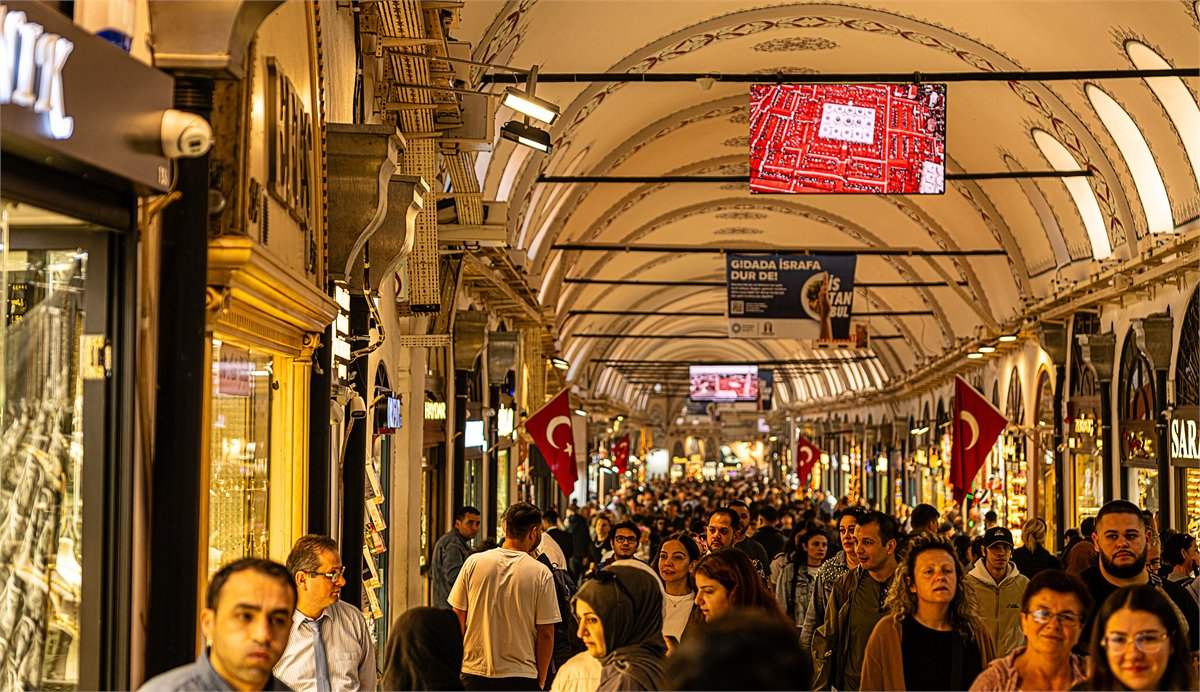
Kapalıçarşı means simply "the covered market", and it has been trading almost continuously since the 1460s. Around four thousand shops sit along some sixty vaulted streets behind twenty-two gates — a roofed town rather than a market, with its own police post, its own mosques, its own restaurants and, historically, its own rules.
It grew outwards from a stone core. Mehmed II built the Inner Bedesten, a fortified hall where the truly valuable goods were locked away each night, and over the centuries the trade spread around it street by street, each named for the craft that once worked there — the quilt-makers, the skullcap-makers, the mirror-makers, the gold-sellers. Fires and earthquakes flattened parts of it repeatedly; it was always rebuilt, because too much of the city's money passed through it not to be.
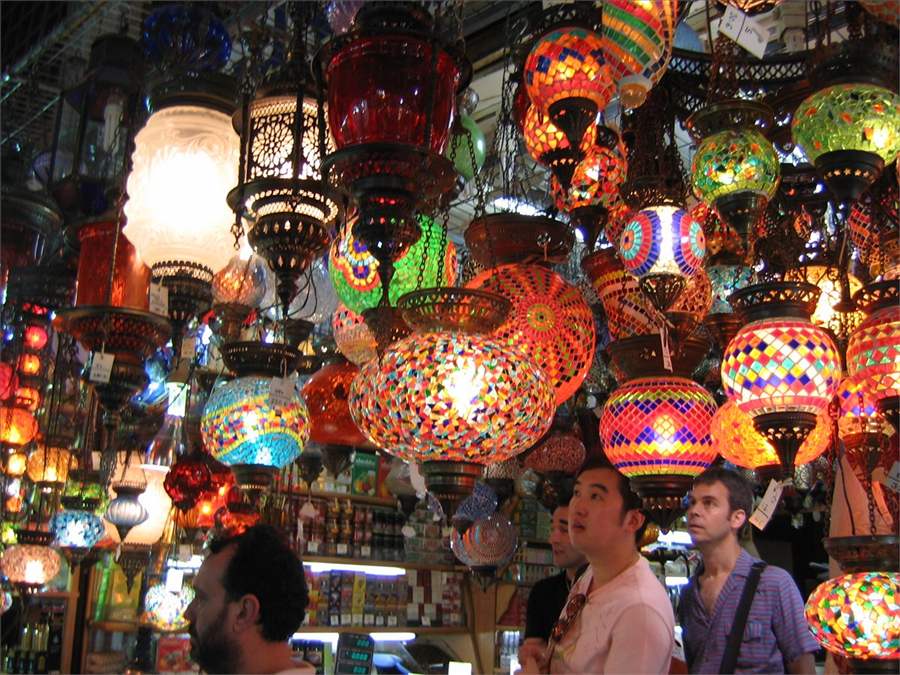
What surprises people is how ordered it is beneath the apparent chaos. Turn one corner and you are among nothing but gold, kilo after kilo of it glittering in identical windows. Turn another and it is all carpets, or all leather, or all lamps throwing colored light across the vaults. The famous confusion comes from the fact that the streets are not straight and the roof hides the sun, so you lose your bearings within about four minutes.
Bargaining is expected, and it is meant to be enjoyable rather than adversarial. You will be offered tea. Accepting it does not oblige you to buy anything — it is simply how business has been conducted here for five hundred years.
Our guide's tip: Ask us before you buy anything significant, especially carpets, gold or "antique" ceramics — we will tell you honestly what a fair price looks like and which shops are genuinely making what they sell. Also: agree a meeting point before anyone wanders. Getting separated in here is a rite of passage. It is closed on Sundays.
You smell it before you reach it. The Spice Bazaar is smaller and far more concentrated than the Grand Bazaar — an L-shaped hall of vaulted arcades where the air is thick with cinnamon, dried mint, cumin and rose. Whatever the season, it is warm in here, and it always smells like somebody is about to cook something wonderful.
Turks call it Mısır Çarşısı, the Egyptian Bazaar, and that name is a small history lesson: it was completed in the 1660s as part of the New Mosque complex just outside, and it was endowed with revenues from the Ottoman province of Egypt. Spices arriving from the east were taxed, sold and redistributed from here, which made this modest hall a serious node in world trade.
Today the spice merchants share space with sellers of Turkish delight, dried apricots and figs, nuts, honeycomb, teas, and pyramids of saffron that photograph beautifully. There is a good deal of theater — you will be offered samples constantly, and the patter is part of the fun — but the quality is genuinely high if you know where to look, and prices per kilo are usually far better than at the airport.
Step outside the back and you land in the far less polished streets where Istanbul actually shops: coffee roasters, cheesemongers, hardware stalls, a coppersmith or two. That contrast, two minutes apart, is one of our favorite things to show people.
Our guide's tip: Real saffron is expensive everywhere — if it is cheap, it is safflower. For Turkish delight, ask for the plain double-roasted pistachio rather than the brightly colored tourist assortments. And just around the corner is a coffee house that has been grinding Turkish coffee since 1871; the queue moves fast and it is the best souvenir you can bring home.
You walk down a short flight of steps from a noisy street and the temperature drops, the sound changes, and suddenly you are in a flooded marble forest. Three hundred and thirty-six columns stand in twelve rows of twenty-eight, lit from below, doubled by their own reflections in the shallow water. Turks call it Yerebatan Sarayı — the sunken palace — and standing in it you understand why.
It is not a temple. It is a water tank, built under Justinian in 532 to supply the Great Palace, fed by aqueducts from forests nearly twenty kilometers away. That is precisely what makes it so moving: this is infrastructure, built with the seriousness other civilizations reserve for cathedrals.
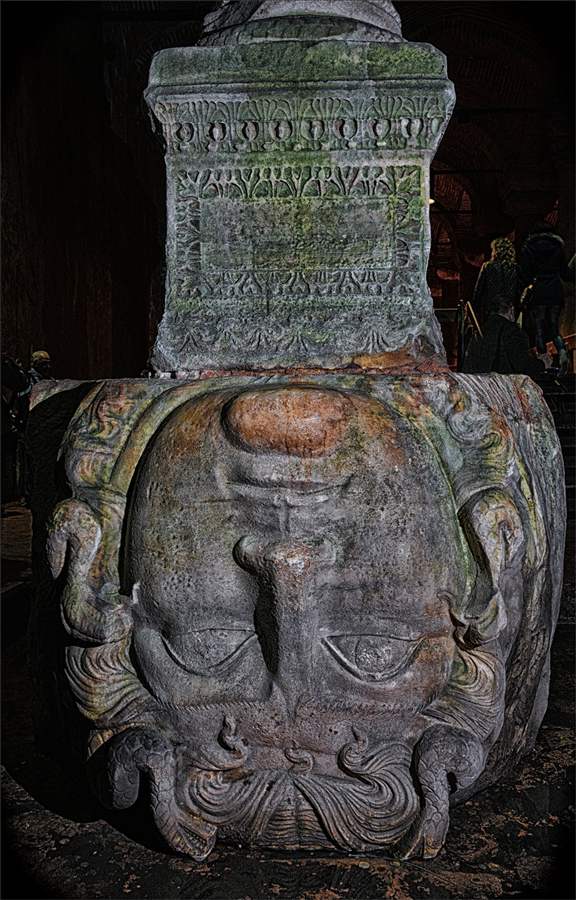
Almost every column was recycled from older Roman buildings, which is why no two capitals quite match. And at the far end, supporting two columns, sit the two famous Medusa heads — one lying on her side, one completely upside down. Nobody knows why. The practical explanation is that they were simply the right size to prop up a column and were laid however they fitted. The nicer explanation is that inverting the Gorgon's gaze robbed her of the power to turn anyone to stone. We tell both and let you choose.
For centuries the city forgot it existed. In the 1540s a Dutch scholar, Petrus Gyllius, noticed that local residents were drawing water — and occasionally fish — up through holes in their basement floors, and went looking for the reason. Millions of visitors since owe him a debt.
Our guide's tip: Bring a light jacket even in August; it is properly cool down there. The walkways can be slick, so sensible shoes help. And look for the column carved all over with what look like teardrops or peacock eyes — tradition ties it to the hundreds of slaves who died building the cistern, and it is easy to walk straight past it.
It looks like a pleasant public park with a few odd monuments in it. In fact you are standing on the floor of a stadium that held tens of thousands of people, and for a thousand years this was the loudest, most dangerous place in the Roman world.
Septimius Severus laid it out around 203, and Constantine enlarged it when he refounded the city as his new capital. Chariots raced anticlockwise around a central spine — the long gentle curve of today's park still traces the track. The crowd split into factions, the Blues and the Greens, and those factions were never only about sport; they were political machines with money and muscle behind them. In 532 they briefly united against the emperor, and the resulting Nika riots burned half the city and are said to have ended with tens of thousands dead on this very ground. Justinian rebuilt Hagia Sophia as a direct consequence.
Three monuments survive on the spine. The Egyptian obelisk is the oldest object standing in Istanbul by a wide margin — carved for Pharaoh Thutmose III around 1500 BC, shipped here and raised in 390, and its pink granite is still so crisp it looks machined. Beside it stands the twisted bronze Serpent Column, cast from the melted-down weapons of the Persians defeated at Plataea in 479 BC and brought here from Delphi; the three snake heads are gone, though one is in the Archaeological Museum. Further along, the rough-stoned Walled Obelisk was once sheathed in gilded bronze — stripped, it is said, by crusaders in 1204.
Our guide's tip: Stand at the southern end and look north, and let us fill the space back in for you — this is one of the places where a guide genuinely changes what you see, because almost everything here is invisible without the story. Note also the ornate German Fountain at the top, a gift from Kaiser Wilhelm II in 1900. It is free, open always, and best walked before the Blue Mosque.
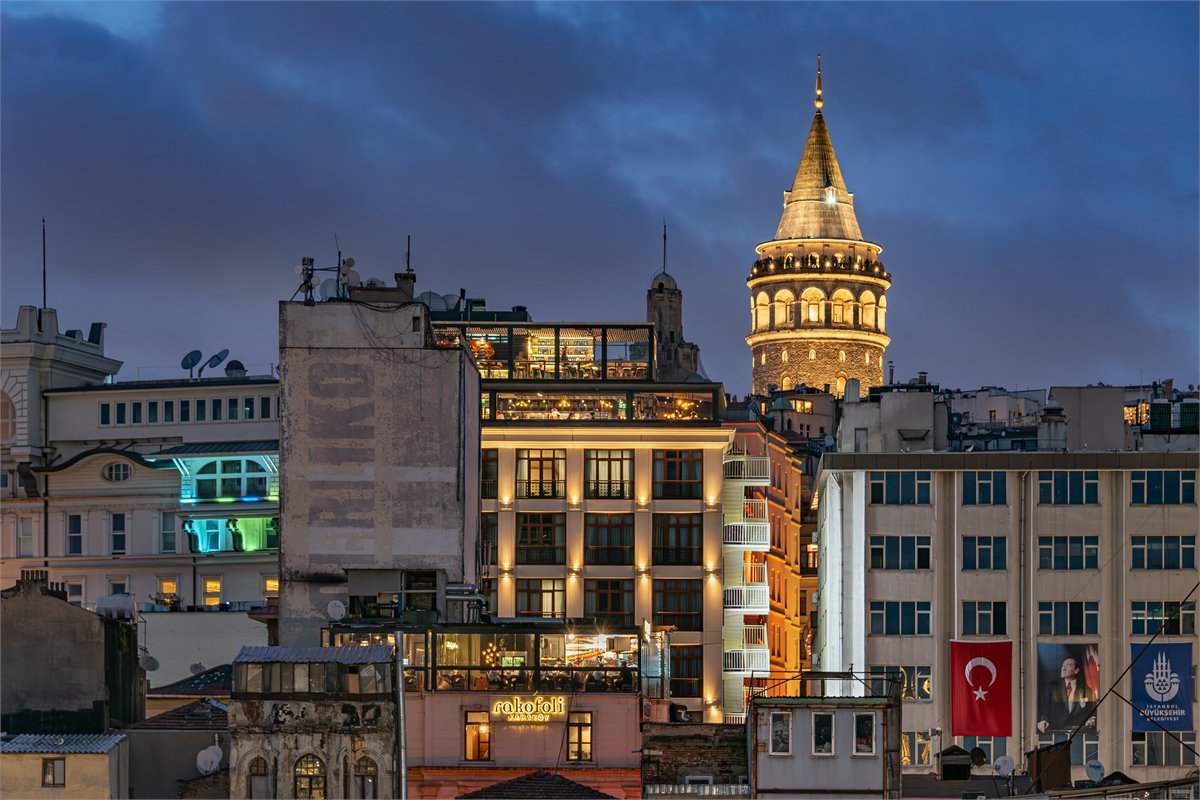
Cross the Golden Horn and the city changes character. The steep lanes climbing up from the water are narrow, shaded and full of music shops, and at the top of them stands a fat stone cylinder about sixty-seven meters high with a conical cap: the Galata Tower, and the best view in Istanbul.
The Genoese built it in 1348 and called it Christea Turris, the Tower of Christ. They were merchants, not conquerors — Byzantium had granted them this hillside as a trading colony — and the tower was the high point of the walls around their little self-governing enclave. From up there they could watch every ship entering the Golden Horn, which was rather the commercial point.
Under the Ottomans it earned its keep in other ways: as a prison, an observatory, and for a long time a fire-watch station, where guards scanned a mostly wooden city for smoke and beat drums when they saw it. And it has one glorious legend attached. The seventeenth-century traveler Evliya Çelebi records that Hezârfen Ahmed Çelebi strapped on a pair of wings, launched himself from this tower, and glided right across the Bosphorus to land in Üsküdar on the Asian side. Historians are skeptical. Istanbul is not.
From the balcony the whole city arranges itself: the old peninsula with Hagia Sophia and the Blue Mosque, the Golden Horn curving inland, the Bosphorus opening north between two continents, and ferries stitching it all together.
Our guide's tip: The queue is the enemy here — it is a single small lift and a narrow balcony, so midday can mean a long wait. Early morning or the last hour before sunset are far better, and sunset is spectacular if you are willing to share the railing. Afterwards, walk down through Galata rather than taking a taxi; the descent to the water is one of the nicest short walks in the city.
Istanbul makes sense from the water. Spend a day walking and you experience the city as hills and traffic; step onto a boat and the whole logic of the place snaps into focus — a thirty-one-kilometer strait joining the Black Sea to the Sea of Marmara, Europe on your left, Asia on your right, and everything that was ever built here arranged along both banks.
The name comes from Greek and means, roughly, "the ford of the ox" — from the myth of Io, transformed into a heifer and driven across this water by a gadfly. Jason and the Argonauts were supposed to have threaded the clashing rocks at its northern mouth. It has always been a place of passage, and it still is: enormous tankers slide past fishing boats, and commuter ferries cross between continents all day long for the price of a bus ticket.
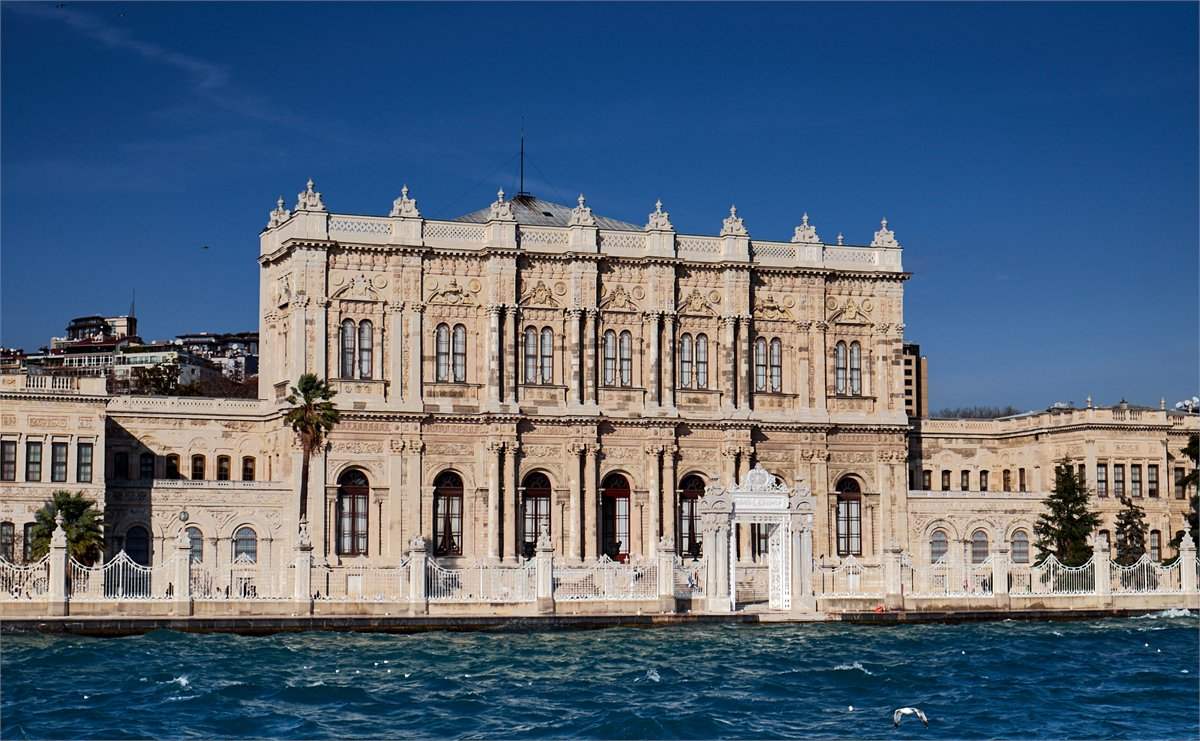
What you actually see from the deck is a parade. The baroque bulk of Dolmabahçe Palace, where the sultans moved when Topkapı began to feel old-fashioned. Ortaköy Mosque tucked beneath the first bridge. Rumeli Hisarı, the great fortress Mehmed II threw up in a matter of months in 1452 to strangle Constantinople's supply line, facing the older Anatolian fortress across the narrowest point. And everywhere along the shore, the yalıs — wooden waterside mansions painted ox-blood red and cream, some of them three hundred years old, and among the most expensive homes on earth.
Then there are the small pleasures. Tea in a tulip glass on the back deck. Seagulls tracking the boat the entire way. The moment the wind changes near the Black Sea and it suddenly feels like a different country.
Our guide's tip: Skip the shortest tourist cruises that just bounce between the two bridges — the strait gets far more beautiful the further north you go. On a private boat we can go up towards Anadolu Kavağı and stop for lunch by the water at a village where the fish comes off the boat that morning. Sit on the right-hand side heading north for the palaces, and bring a layer: it is always windier out there than it looks from shore.
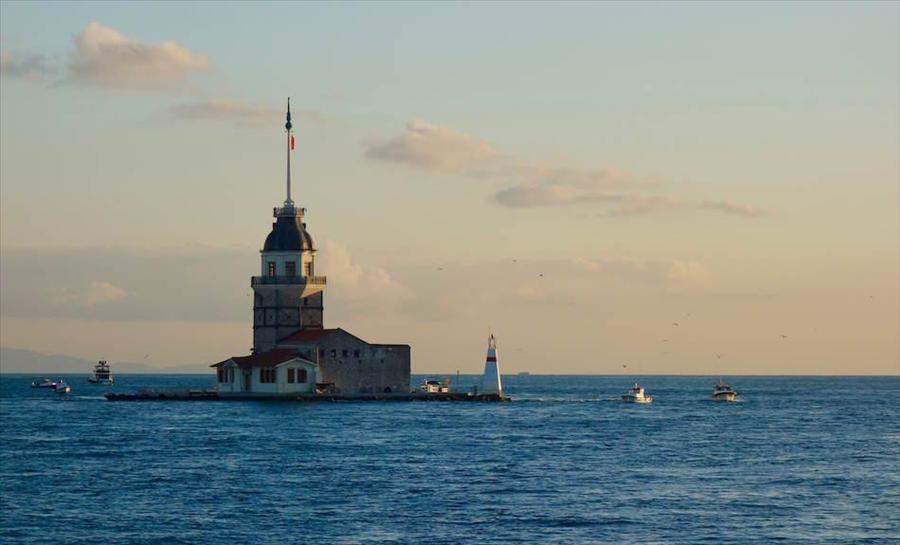
It sits on a rock barely bigger than itself, a few hundred meters off the Asian shore at Üsküdar, exactly where the Bosphorus opens into the Sea of Marmara. Kız Kulesi — the Maiden's Tower — is small, white, improbable, and it is on more Istanbul postcards than almost anything else. At sunset, with the old city glowing behind it, you understand why.
Something has stood here for around two and a half thousand years. The Athenian general Alcibiades is credited with putting up a customs post on the rock in about 410 BC to tax ships coming down from the Black Sea. The Byzantines fortified it, and there was once a chain that could be run from here to close the strait entirely. What you see today is largely eighteenth and nineteenth century, rebuilt after fire and earthquake, and restored again very recently.
The legend everyone asks about: an emperor — or a sultan, depending who is telling it — was warned by a prophecy that his beloved daughter would die of a snakebite on her eighteenth birthday. To defeat fate he had her placed on this island, untouched by land. On her birthday he brought her a basket of fruit to celebrate. A viper had traveled in with the grapes. It is a beautiful, useless story, and Istanbul has been telling it for centuries.
Since then the tower has been a lighthouse, a quarantine station during a cholera outbreak, a radio post and a customs office. Now it is a museum and café, and you can take a small boat across and stand on the terrace looking straight back at the skyline.
Our guide's tip: The best photograph of the tower is not from the tower — it is from the waterfront promenade at Salacak on the Asian side, about an hour before sunset, when the light comes over your shoulder and hits the tower with Sultanahmet behind it. Very few visitors cross to Üsküdar at all, which is exactly why we like taking people there.
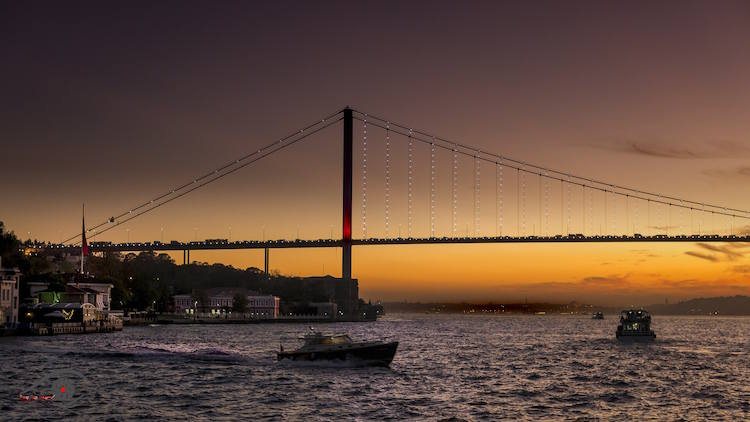
Some views are famous for a reason. Ortaköy Mosque stands directly on the water's edge, all pale carved stone and tall windows, and rising behind it is the vast steel span of the first Bosphorus bridge. Six centuries of Ottoman architecture and a piece of twentieth-century engineering, framed together in one photograph — and it works.
Its proper name is the Büyük Mecidiye Mosque, built for Sultan Abdülmecid I and completed around 1856. The architects were Garabet Balyan and his son Nigoğayos, from the Armenian family who designed much of imperial Istanbul in this period, including Dolmabahçe just down the shore. The style is Neo-Baroque, which is to say it is far more European than the classical Ottoman mosques of the old city — curved, ornamented, and full of light, with windows angled so that reflections off the Bosphorus move across the interior walls all day.
The square around it is one of the most relaxed places in the city. On weekends there is a small art and craft market, students sit on the steps down to the water, and fishing boats knock against the wall. It is also the home of two ferociously popular street foods: kumpir, an enormous baked potato mashed with butter and cheese and then buried under whatever toppings you point at, and thick waffles loaded with fruit and chocolate. Neither is remotely traditional. Both are a very good time.
Our guide's tip: Come in the late afternoon, when the light turns gold on the mosque and the bridge starts to switch on. It pairs perfectly with a Bosphorus cruise — we often finish on the water here rather than starting. And if you only try one thing, make it the kumpir; just be warned that "a little of everything" arrives as a mountain.
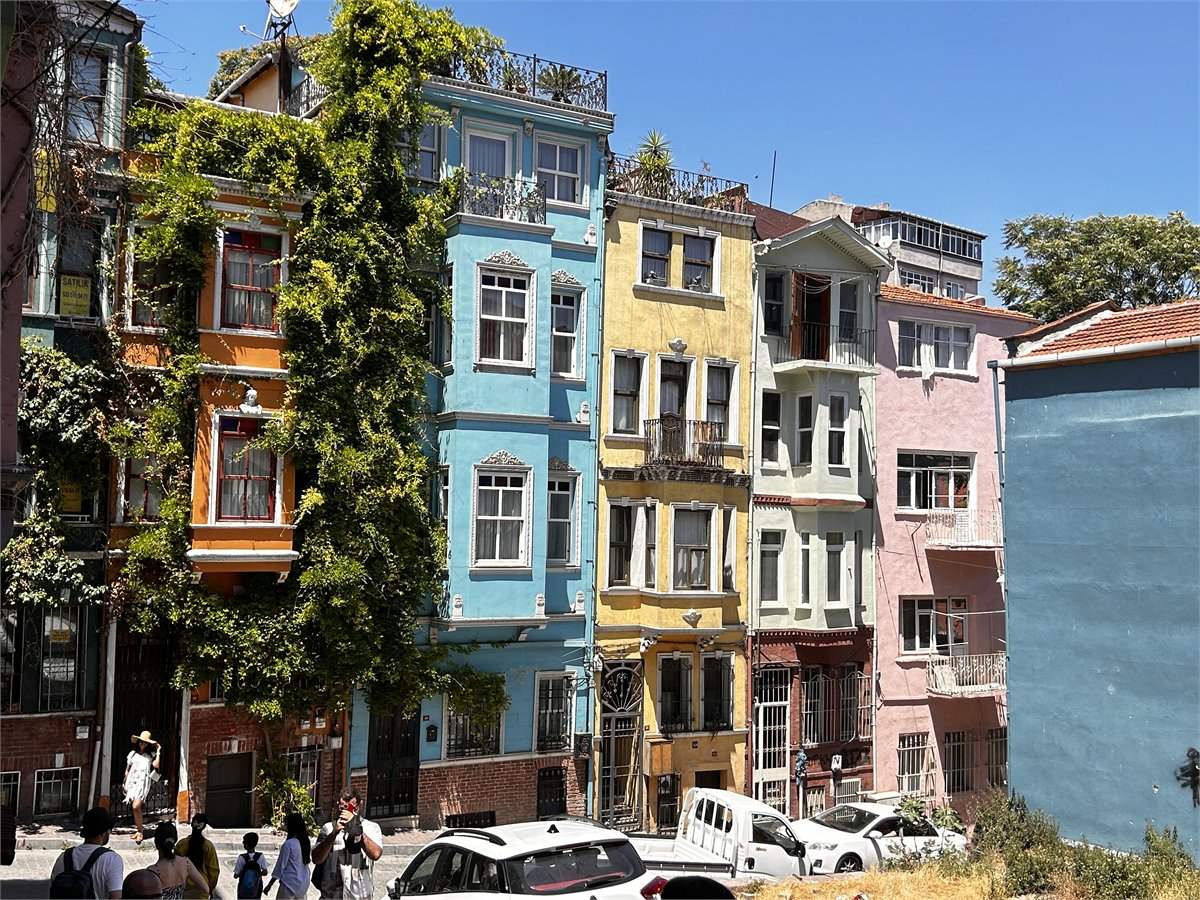
Balat is the Istanbul people fall in love with by accident. Steep cobbled lanes run down towards the Golden Horn between tall narrow houses painted in every color anyone had to hand — ochre, pistachio, deep red, cobalt — with laundry strung between them and cats asleep on every wall. It has become popular with photographers in recent years, and deservedly, but it is still a real neighborhood where people are carrying bread home.
The history here is the good kind. Balat was for centuries the Jewish quarter of the city, and Fener next door was the Greek Orthodox one; Armenians lived alongside both. That layering is still legible on the ground. The Ahrida Synagogue, one of the oldest in the city, dates in some form to before the Ottoman conquest and has a reader's platform shaped like the prow of a ship. A few streets away stands the Ecumenical Patriarchate, still the spiritual center of Orthodox Christianity worldwide. Above them looms the enormous red-brick Greek College, which everybody calls the castle.
Our favorite oddity is the Bulgarian church of St. Stephen, down on the waterfront. It looks like carved stone from a distance. It is in fact made of cast iron — the pieces were manufactured in Vienna, shipped down the Danube and across the Black Sea, and bolted together here in 1898.
These days the ground floors along Vodina Caddesi have filled up with antique shops, coffee places and small restaurants, and it is one of the pleasantest afternoons you can spend in the city — no queues, no tickets, just wandering.
Our guide's tip: Wear real shoes; those lanes are steep and the cobbles are uneven. The most photographed row of colored houses is on Kiremit Caddesi, and remember that people actually live behind those doors. Since you are already this far up the Golden Horn, it is the natural moment to add the Chora Church nearby — its Byzantine mosaics are, to our mind, the finest in the world, and most visitors to Istanbul never see them.