- Who the Byzantine tour is for
- Second-visit travelers, readers of history, pilgrims and art lovers — not a first day in Istanbul, and we say so
- What the Byzantine tour costs
- From €150 per group per day — not per person, guide and private car included; tickets at cost
- Duration
- About 8 hours, door to door
- Not on a Friday
- The Chora is closed to sightseeing on Fridays and Hagia Sophia pauses for the Friday prayer; any other day works
- Walking
- About 6 km, with stairs at Hagia Sophia and uneven ground at the walls — flat, comfortable shoes
- Working mosques
- Hagia Sophia and the Chora pause visits around each daily prayer; we plan the order around them
This tour from €150 per group, per day
Licensed local guide, private car and driver, and skip-the-line priority entrance. The day runs at your pace, and the plan stays yours to change.
Get my free quoteTÜRSAB-licensed agency No. 15746 · nothing to pay to ask · a real person replies within 24 hours
What it costs, in full
From €150 per group, per day — not per person
- Licensed local guide for the whole day included
- Private car and driver, hotel or port pick-up and drop-off included
- Planning, timed entries and the priority-entrance tickets included
- Museum and palace entrance tickets at the gate price, no markup
- Lunch, drinks and anything you choose to buy not included
- Tips for your guide and driver customary, entirely up to you
Two people or six, the tour price is the same — it is the day you are hiring, not a seat. Entrance tickets are the only thing quoted separately, because museum prices change and because some parties add the Harem or the Cistern and others do not; we buy them in advance at the price on the gate and add them to your quote before you decide anything. Everything is quoted in euros, and nothing is paid until the day is agreed.
Every tour is priced individually: your quote is calculated for your travel date and season, the number of guests, and your starting and finishing points.
Get your quoteHow the day runs
Timings below are the ones we actually use, not a brochure. Everything here is movable — it is your day, and your guide will happily rebuild it over breakfast.
- 08:30
Pick-up
From your hotel or the ship. We start at Hagia Sophia because it is the one building on this day that gets worse by the hour, and because the rest of Constantinople makes more sense once you have stood in it.
- 09:00
Hagia Sophia, as a church
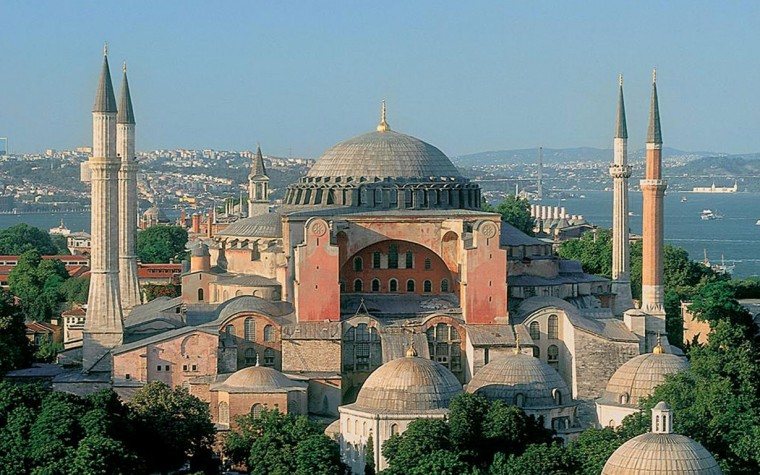
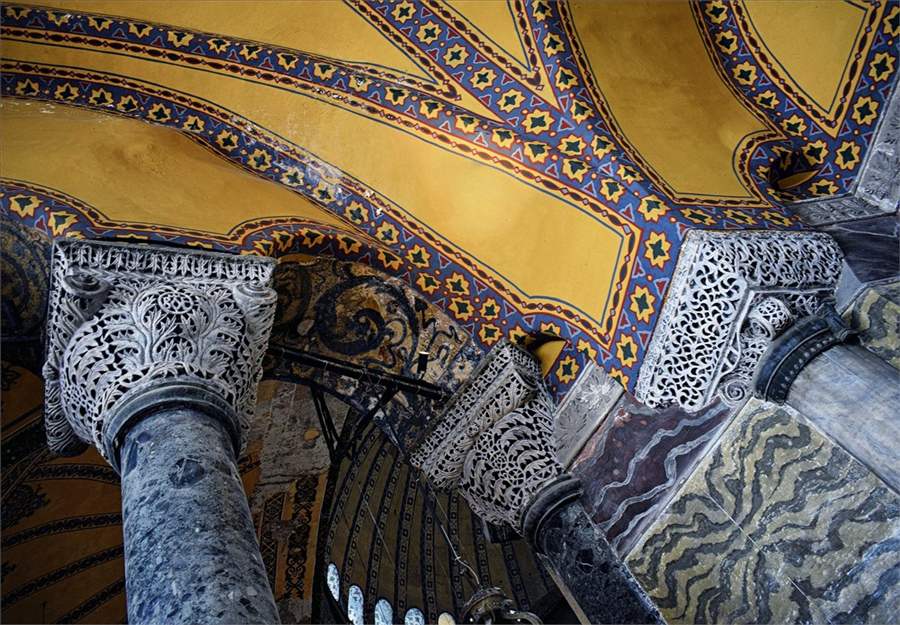
Dedicated by Justinian in 537, designed by a mathematician and a physicist, Anthemius of Tralles and Isidore of Miletus, and the largest enclosed space in the world for most of a thousand years. Visitors see it from the upper gallery now, which is where the mosaics are: the Deesis of about 1261, the empress Zoe and her third husband, John II Komnenos and Irene. On the way out, the Imperial Gate panel of an emperor kneeling before Christ, and the vestibule mosaic of Constantine offering the city and Justinian the church to the Virgin.
- 10:30
The Hippodrome, the spine of the city
A long public garden today; the city's circus, parade ground and parliament for a thousand years. The Serpent Column came from Delphi, cast after the Greek victory over Persia in 479 BC. The obelisk is Thutmose III's, raised here in 390 under Theodosius, its base carved with the emperor watching the races. The Nika riots ended on this ground in 532, and most of the old city we see next was built out of their ashes.
- 11:00
The Basilica Cistern
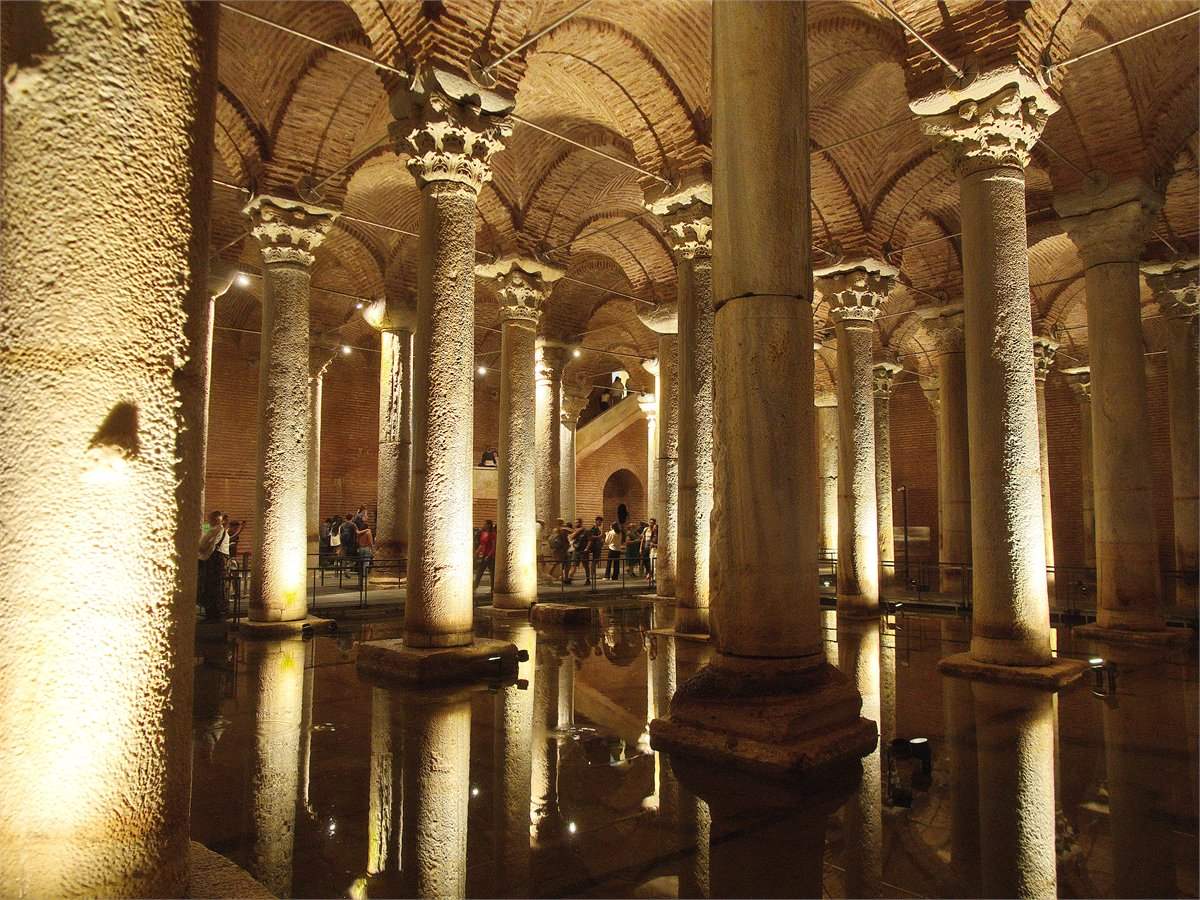
Justinian's water store, built after the riots, with 336 columns salvaged from older temples, which is why none of them match and why two Medusa heads lie sideways and upside down under the north-west corner. Underground, cool, and the most atmospheric fifteen minutes of the morning.
- 11:45
Hagia Irene, when it is open
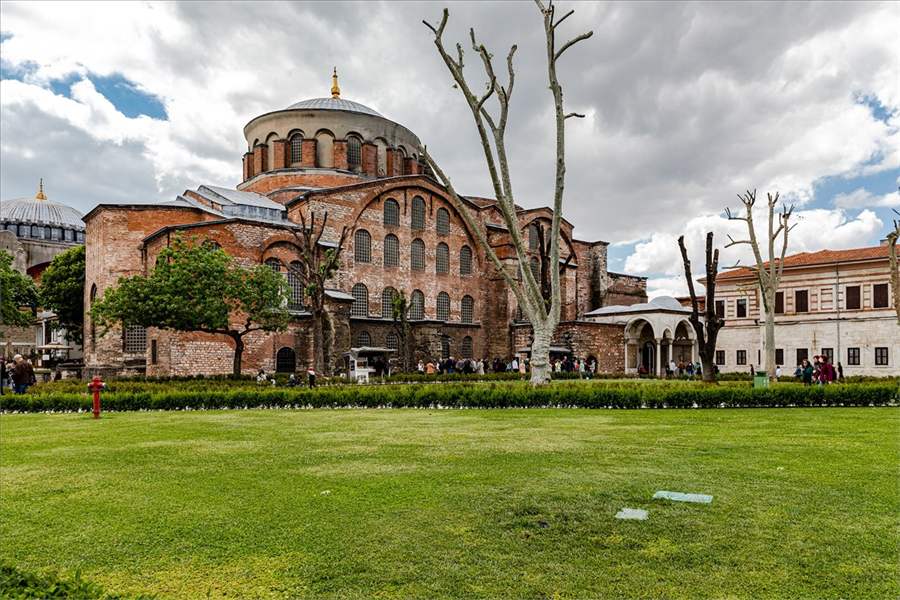
In Topkapı's first courtyard, the first great church of Constantinople and the only one never turned into a mosque; the Ottomans used it as an arsenal. Rebuilt under Justinian after the riots, it keeps the plain mosaic cross put in its apse in the eighth century, when the iconoclast emperors had the figures taken down. It is a museum with its own ticket and its own closing day, so we check it for your date and, if it is shut, use the time at the Column of Constantine on the drive.
- 12:30
Lunch in Fatih
We drive west along the old Mese, the imperial avenue the modern tram follows, to a neighborhood lunch near Fatih or Edirnekapı. We point out a couple of honest places or sit down with you. Take the full hour; the afternoon is on your feet.
- 14:00
The Chora: the mosaics and frescoes
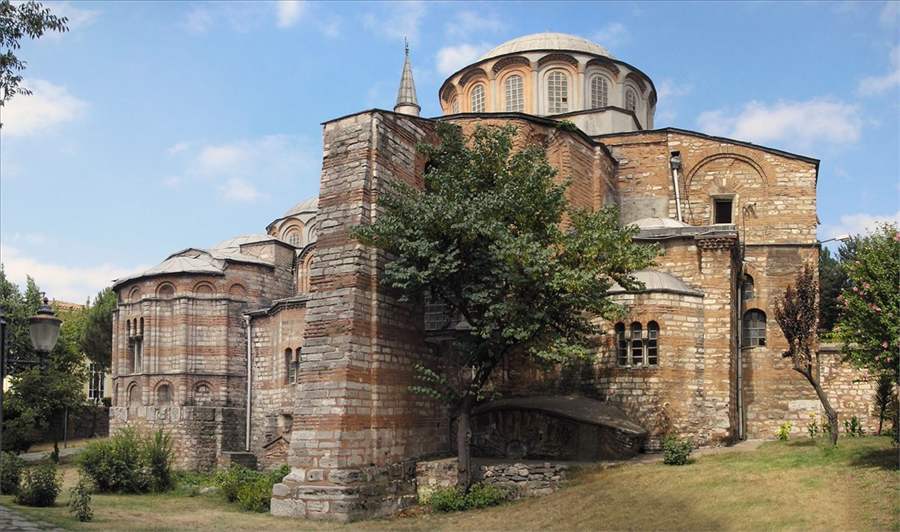
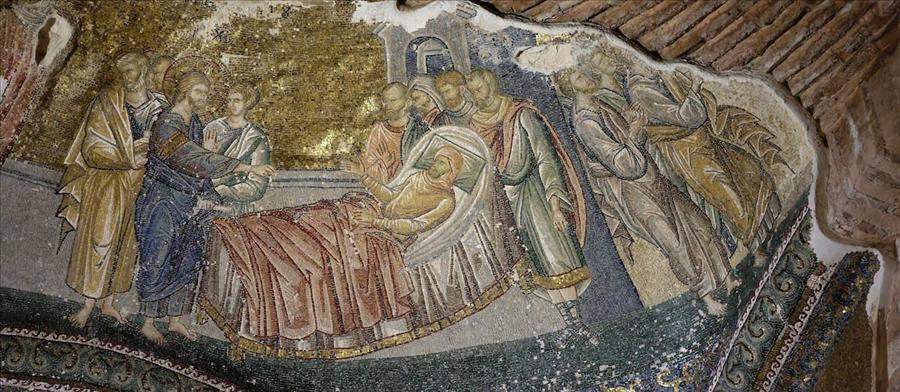
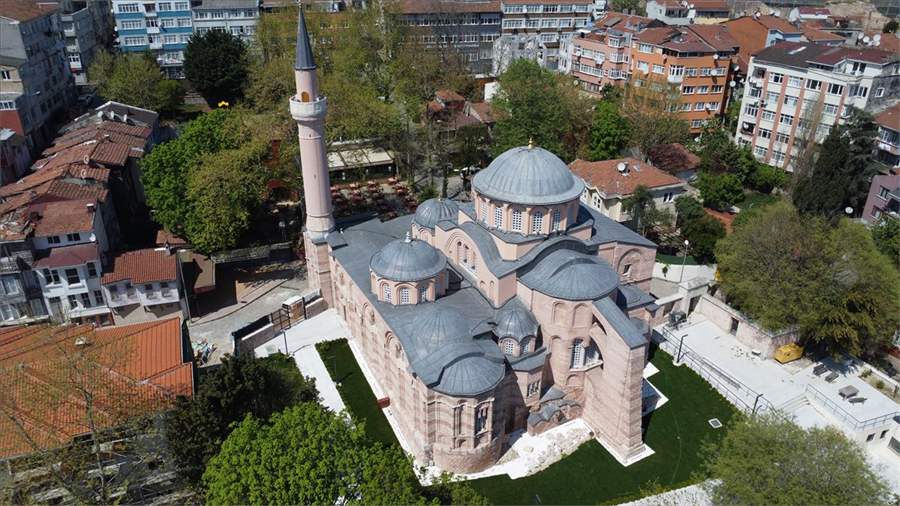
Theodore Metochites, the emperor's chief minister, paid for the decoration between about 1316 and 1321, and it is the best Byzantine art of its century anywhere. The outer narthex tells Christ's infancy and miracles; the inner narthex the life of the Virgin from her parents' prayers, with the Deesis and Metochites himself kneeling to offer the church. Then the side chapel he built as his tomb: the Anastasis in the apse, Christ hauling Adam and Eve out of their sarcophagi with the broken gates of hell under his feet. He was exiled after 1328 and came back to die here as a monk. The nave is a prayer hall now; the narthexes and the chapel are where the art is.
- 15:30
The Theodosian land walls
Five minutes on foot from the Chora to Edirnekapı, the highest point of the old city. Theodosius II's prefect Anthemius finished the wall in 413, and a second line and a moat were added after the earthquake of 447: about six and a half kilometers from the Marmara to the Golden Horn, which stopped every army for a thousand years until Mehmed II's cannon in 1453. We walk a stretch, see the Palace of the Porphyrogenitus beside the gate, and are honest that some of it is restored and some of it is rubble.
- 16:30
Back
The car meets us at the gate. Hotel, or Galataport for ship guests, with the day's two drives already done.
What's included
- A licensed local guide for the whole day, in English, Spanish, Portuguese, French, Russian, Italian or German
- Private air-conditioned car and driver, including the drives across the old city to the Chora and the walls
- Hotel or cruise-port pick-up and drop-off
- Skip-the-line priority entrance at Hagia Sophia, the Basilica Cistern and the Chora — we hold the tickets before you arrive
- All the planning — the prayer-time pauses at two working mosques, the Friday rule at the Chora, and the order that keeps the story straight
Not included
- Entrance tickets — Hagia Sophia, the Basilica Cistern, the Chora, and Hagia Irene when it is open — bought in advance at the gate price, with no markup, and added to your quote
- Lunch and drinks
- Tips for your guide and driver — customary, but entirely up to you
- Anything you decide to buy
Priority access · included
Skip the line at every gate
Three ticket lines on this day: the visitor entrance at Hagia Sophia, the Basilica Cistern office, and the ticket point at the Chora. Your guide holds all three before you arrive, bought at the official price with nothing added, so you walk to the door. What no pass can change: Hagia Sophia and the Chora are working mosques, and both pause sightseeing around each prayer. We build the day around those pauses rather than pretend they are not there.
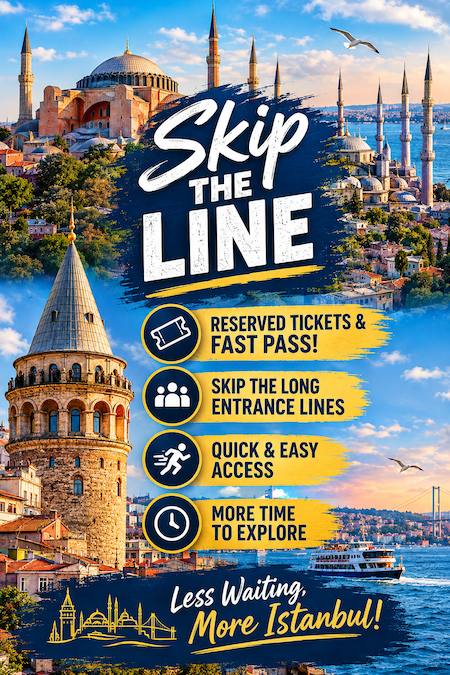
- Skip-the-line tickets — bought before your day, never at the gate with you standing in the line
- Fast pass at the busiest sites — the priority lane wherever a site operates one
- Priority entrance in every region — Istanbul, Ephesus, Cappadocia, Pamukkale and everywhere else we guide
- Nothing added to the tickets — we add nothing on the fast-pass tickets. You pay exactly the official price charged at the entrance, set by the Ministry of Culture and Tourism or the administration that runs the site
To be precise about what this is: we skip the ticket line, not the security check, and no agency can override a site's own capacity limits.
Where we meet, and what happens if plans change
- Meeting point: Your hotel, or the cruise terminal at Galataport. Your guide is there before the time on the ticket, not after it.
- Starts: around 08:30 — earlier if you want the sights before the crowds, later if you would rather sleep.
- Ends: about 16:30, back at your hotel or wherever you would like to be dropped.
- Group size: private — only your party, never a shared minibus.
- Language: English, Spanish, Portuguese, French, Russian, Italian or German. Tell us which when you write, and your guide will be licensed in that language.
- Cancellation: you pay nothing to book, so there is nothing to lose. Tell us as early as you can and we will move the day or cancel it, at no cost.
Staying in a hotel? Then the meeting point is your lobby and there is nothing to find — this map is for guests arriving by ship.
Shopping, if you would like to
Türkiye’s crafts are one of the pleasures of being here, and many guests ask to see a carpet, leather or jewelry atelier while they are in Istanbul. If you would like to, we are glad to include one — we use only established, fully insured workshops of the kind the cruise lines recommend, where you are welcome to watch the craft, enjoy the tea and take as long as you like. Nobody will hurry you and nobody will press you to buy. And if you would rather give the whole day to the sights, simply say so and we will. Read our guide to shopping in Istanbul.
The Byzantine Constantinople tour is one private day spent on the Christian city that lies under Ottoman Istanbul, from €150 for the whole group. Constantinople was the capital of the Roman Empire in the east from 330 to 1453, longer than Rome itself was a capital, and most of what survives of it is in plain sight and walked past. This day stops and reads it.
Why is a Byzantine tour of Istanbul different from the Old City tour?
Our Best of Istanbul day covers Sultanahmet from both sides, Byzantine and Ottoman, in one walkable square kilometer. This day gives up the Blue Mosque, Topkapı and the Grand Bazaar to go where the Byzantine story continues: across the old city to the Chora and the land walls, with a car between. It is more driving, more walking, and a narrower subject, told properly. Think of it as the second day, or the first day for someone who came for Constantinople.
What you will see, and what is left of it
| Stop | What it was | What survives |
|---|---|---|
| Hagia Sophia | The cathedral of the empire, 537 | The whole building, and the gallery mosaics; a working mosque, visited from the gallery |
| The Hippodrome | The circus and the city's political arena | Three monuments on the spine, the sunken outline of the track, the curved end under the streets |
| Basilica Cistern | Justinian's water reserve, 6th century | Intact: 336 columns, the Medusa heads |
| Hagia Irene | The first great church, rebuilt 6th century | Intact shell and the iconoclast cross; a museum with its own closing day |
| The Chora | A monastery church, decorated 1316–1321 | The finest mosaics and frescoes of late Byzantium; a mosque since 2024, art on view outside prayers |
| The land walls | Theodosius II's defenses, 413 onward | Most of the 6.5 km line, in states from restored to ruined |
Hagia Sophia as a church, not a monument
Most visitors are shown Hagia Sophia as a list of superlatives and a change of hands. We read it as the building Justinian consecrated in 537, where every emperor after him was crowned and where the Latin crusaders of 1204 and the last liturgy of 1453 both happened. Since visitors now see it from the upper gallery, we spend the time where the gallery is strongest: the Deesis panel, with the most humane Christ in Byzantine art, the imperial panels of Zoe and of John II and Irene, and the graffiti a Viking guardsman scratched into the marble. On the way out, the lunette over the Imperial Gate and the vestibule mosaic of the two founders presenting their gifts, which is the whole idea of the city in one picture.
The Hippodrome and the Cistern: the city Justinian rebuilt
In January 532 the two circus factions joined forces and burned half the capital in the Nika riots, and the suppression ended on the floor of the Hippodrome. Nearly everything we see in Sultanahmet dates from the rebuilding that followed: Hagia Sophia, Hagia Irene and the Basilica Cistern, whose 336 mismatched columns were salvaged from older buildings in a hurry. The Hippodrome itself is older, Septimius Severus's circus enlarged by Constantine for his new capital in 330, and its three surviving monuments are a Greek bronze from Delphi, an Egyptian obelisk thirty-five centuries old, and a tenth-century pillar stripped of its bronze by the crusaders. Standing between them is the clearest fifteen minutes of history in the city, and your guide's job is to make the missing building appear.
The Chora: why it is the heart of this day
Nothing else in Istanbul shows you Byzantine painting at this level. The Chora was a monastery outside Constantine's original wall and inside Theodosius's, hence the name, "in the country". Theodore Metochites, scholar, astronomer and the emperor Andronikos II's chief minister, rebuilt and decorated it between about 1316 and 1321, and the result is the best surviving work of the late Byzantine renaissance: two narthexes of mosaic on gold, and a funerary chapel painted in fresco. Your guide takes the cycles in order, because they are meant to be read in order: the Virgin's life from her parents' prayers to her betrothal, Christ's infancy and miracles, Metochites kneeling in his enormous hat to offer the church, and in the chapel the Anastasis, Christ breaking the gates of hell and pulling Adam and Eve bodily from their tombs. Metochites fell with his emperor in 1328, was exiled, and was allowed back to die in his own monastery in 1332 as the monk Theoleptos.
What you need to know about visiting it now, honestly: it reopened in May 2024 as the Kariye Mosque after four years of restoration. Foreign visitors buy a ticket, which we hold in advance at the gate price. The narthexes and the chapel, where almost all the art is, are open to visitors; the nave is a carpeted prayer hall and its mosaics are curtained during prayers. Sightseeing pauses around each daily prayer and Fridays are kept for worship, so this tour does not run on a Friday. We confirm the arrangement before your date rather than rely on what a guidebook printed last year.
The walls: the unglamorous part, and why we keep it
Five minutes from the Chora on foot is Edirnekapı, the gate on the highest ground of the old city, and the Theodosian land walls run away from it in both directions. Built under Theodosius II in 413 and doubled with an outer wall and a moat after the earthquake of 447, the line held for a thousand years and was breached only once, by the Ottoman cannon of 1453. We tell you plainly: some stretches are cleanly restored, some are weeds and tumbled stone, and there are no handrails on the old sections. It is still the single most impressive Roman fortification standing anywhere, and the fall of the city, the event that ends this day's story, only makes sense when you are standing on it. Beside the gate is the Palace of the Porphyrogenitus, the one Byzantine palace with its walls still up. From the top of the walls you look down over Balat and Fener, the Greek Patriarchate still at the foot of the hill; many guests pair that neighborhood with this day on a second morning.
What does the Byzantine Constantinople tour cost?
From €150 per group, per day — not per person. Two travelers or six, the guide and the car cost the same.
| What you are quoted | How it works |
|---|---|
| From €150 per group, per day | Guide, private car and driver, pick-up, and the planning of the whole day around the prayer pauses |
| Entrance tickets | Hagia Sophia, the Basilica Cistern, the Chora and, when open, Hagia Irene, bought in advance at the gate price with no markup and added to your quote. Gezginol is a licensed TÜRSAB agency, number 15746, which is how we enter by the priority entrance |
| Lunch, drinks and tips | Outside the price. Tips for your guide and driver are customary, and entirely at your discretion |
Ticket prices at these sites are set by the Ministry and by the Directorate of Foundations and are revised often, so we print no figure here; ask us for the current one. Our skip-the-line guide explains what the priority entrance saves and what it cannot.
Can you change the day?
Always: the itinerary above is a shape, not a contract. Readers of church history often ask for the Church of St Mary of the Mongols in Fener, the one church of the city that has stayed Greek Orthodox since before 1453, or the Pammakaristos mosaics at the Fethiye Mosque near the Chora, and we fit either in. Some guests give the walls more time and walk down to the Golden Horn; some give them less. If you would like to see a carpet, leather or jewelry atelier on the way back, we are glad to add one: established, fully insured addresses of the kind the cruise lines recommend, where you take as long as you like and are never obliged to buy. Tell us what you have read and we build the day around it.
Can cruise guests do the Byzantine tour?
Yes, and it is a good choice for a repeat call at Galataport, when the ship's own Old City tour has already been done. We plan backward from your all-aboard time, as our shore excursion page explains, and the walls walk is the part we shorten first if the roads are slow. For a first call, take the Best of Istanbul tour or our Galataport shore excursion instead; the Sultanahmet old city is where a first day belongs.
See all our private Istanbul tours, or send us your dates, any day but a Friday. From €150 per group per day, tickets in hand, Constantinople read properly.
Byzantine Constantinople — frequently asked questions
Is the Byzantine Constantinople tour right for a first visit to Istanbul?
How much walking is there on the Byzantine tour?
Is the Chora Church open, and what can we see inside?
Is the Byzantine tour suitable for children?
Which days does the Byzantine Constantinople tour run?
What does skip-the-line mean on a day with two working mosques?
What you'll see
About the reviews you see here. Every quote on this website is a message a guest actually sent us, printed word for word. We do not write them, we do not edit them, and we do not have a TripAdvisor, Viator or GetYourGuide page to send you to, because we have never sold through those platforms — so there is no star rating for us to show you. We would rather tell you that than put stars on a page and hope you do not check.
Ask us about this day
Tell us your dates and what you would like to see. We reply personally, usually within 24 hours — and if this itinerary is not quite right for you, we will say so and suggest a better one.
Get my free quoteFrom €150 per group · TÜRSAB-licensed agency No. 15746 · skip-the-line entrance · no prepayment to inquire